

Overview
Monite allows its partners to manage and customize outgoing emails to enhance branding and, thus, deliver a unique experience for all entities. Monite uses templates to standardize email creation, providing partners with a solid foundation for customizations. Email templates contain a set of variables and expressions that get replaced when the actual email is rendered. Monite provides a set of predefined email templates for each action. These template types are called system templates.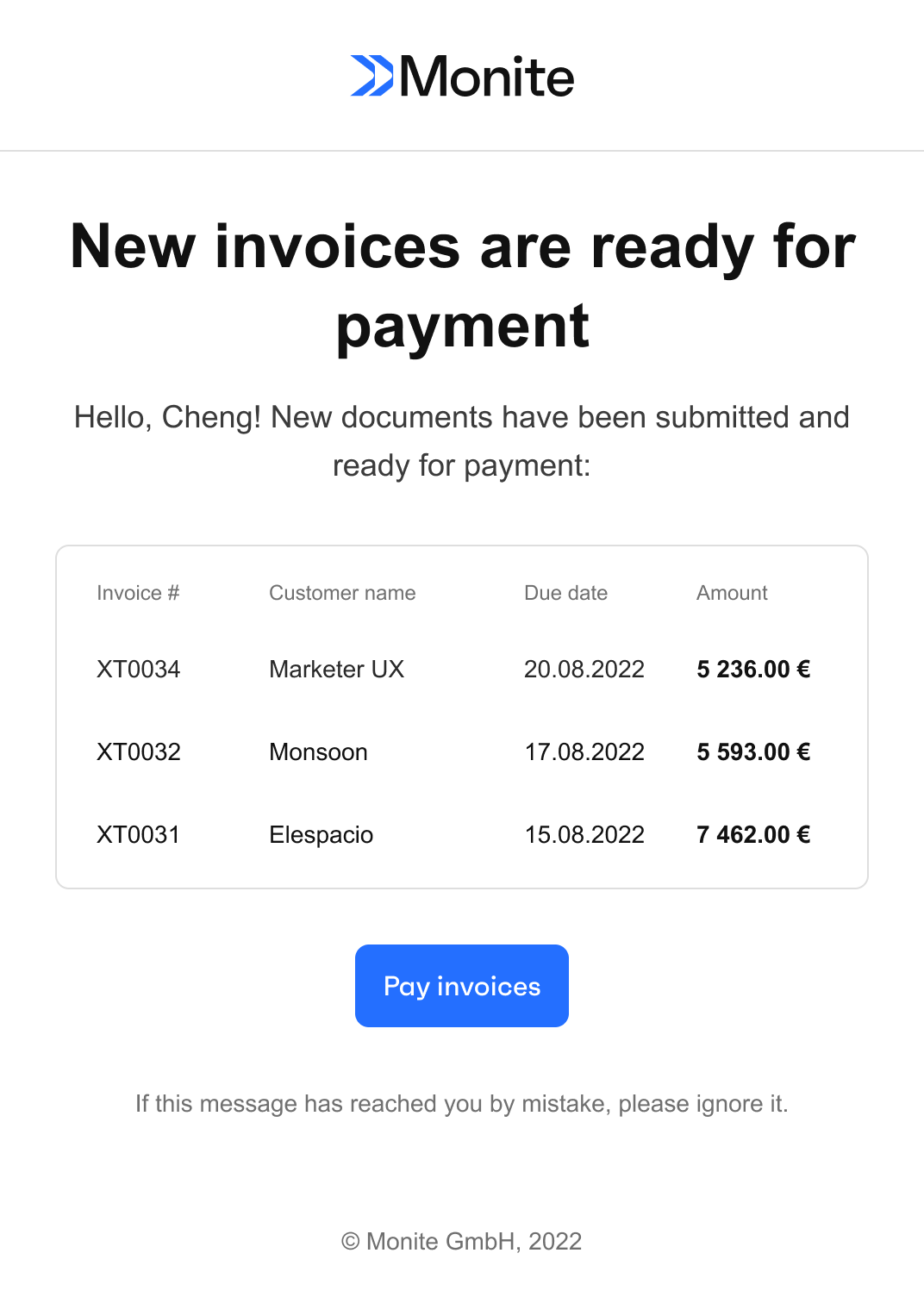
Entity logoIf the entity has a logo, outgoing emails from that entity will display the entity logo uploaded. Emails from entities without a logo will bear the Monite logo. For more information, see Update entity logo.
Template localization
Monite also supports the localization of email templates. Email template localization defines the language, date format, and usage of delimiters on currencies and other figures on an email template. By default, Monite provides localization of system templates for partners and entities in the UK, France, Germany, Spain, and the Netherlands. However, you can create custom email templates for as many languages or locales as you require by using thelanguage field on the POST /mail_templates endpoint. The language parameter accepts ISO 639-1 standard and defines currency and date formatting for all locales provided.
For every language you provide, Monite allows you to select a default template for each template type. For example, you can have default templates for sending invoice emails in English, Spanish, etc.
All email template variables must be provided in English regardless of the template’s language. For more information, see Variable list.
Custom templates
Custom templates allow Monite partners to personalize and customize their email content. Monite provides the/mail_templates endpoint to create and manage email templates. You can customize email subjects and bodies using the subject_template and body_template fields in the request body. You can also embed Monite text templates within these fields as variables.
Embedded text templatesThe text template used as a variable within a mail template must match the text template’s document type. For example, a text template type of
email_body created for the invoice document type is only compatible with the body_template field of an invoice’s mail template. For more information, see Text templates.Email template syntax
- Monite uses the Jinja templating engine for email customizations. Therefore, all email body and subject templates must comply with the Jinja2 template syntax.
- You can only use Monite’s predefined variables to create and update custom templates. Using custom logic or conditionals within variables in your email templates will throw an error.
Template types
The following table contains the names of customizable Monite email templates and their corresponding email action:| Template type | Description |
|---|---|
receivables_credit_note | Used when a credit note is sent to a counterpart. |
receivables_discount_reminder | Sent to a counterpart on early discount dates as defined by the invoice payment terms. |
receivables_final_reminder | This is the final reminder sent to a counterpart before the invoice due date as defined by the payment terms. |
receivables_invoice | Used when an invoice is sent to a counterpart. |
receivables_paid_invoice | Used when a paid invoice is sent to a counterpart. This template is similar to receivables_invoice but with the Pay invoice link removed. |
receivables_quote | Used when a quote is sent to a counterpart. |
payables_notify_approver | Sent to a payable’s list of approvers as defined by the approval policy. |
payables_notify_payer | Unused. |
payables_purchase_order | Used when a purchase order is sent to a counterpart. |